

Business Health Assessment
Growth Mapping X
• Seventy-five points
• About thirty days
• $1,500
A business health assessment answers a question most owners can only guess at: of everything that could be improved, which thing is actually costing you the most right now.
Growth Mapping X measures seventy-five points across three areas — Purpose, Process and People. It is not a questionnaire with a sales call attached. It takes about thirty days, it produces a written map, and it names the danger zones: the places where something is going to break if nothing changes. The "X" is the value multiplier — the part of a business's worth that never shows up on a financial statement.
Growth Mapping X measures seventy-five points across three areas — Purpose, Process and People. It is not a questionnaire with a sales call attached. It takes about thirty days, it produces a written map, and it names the danger zones: the places where something is going to break if nothing changes. The "X" is the value multiplier — the part of a business's worth that never shows up on a financial statement.

What is a business health assessment?
A business health assessment is a structured measurement of how a company is actually performing across its fundamentals, rather than its revenue alone. A business health assessment for small business covers Purpose (sales), Process (systems) and People (team) — producing evidence about which weakness is costing the most, instead of an opinion about what to fix first.
What does the seventy-five point business assessment cover?
Purpose
Whether the business knows who it is for, what it promises, and whether anyone inside it would describe that the same way. Think growth and sales messaging.
Process
Where work actually gets done, where it stalls, and which systems are quietly not delivering what you built them to deliver. Think systems and delivery.
People
Who owns what, what happens when you are not in the room, and whether the team you have matches the business you are trying to run. Think team and direction.
The fifteen categories we score.
Each foundation breaks into five categories. Each category is five questions. Seventy-five questions, and a number for every one of them — which is what makes this a business diagnostic tool for owners rather than a conversation starter.
PURPOSE
PROCESS
PEOPLE
Business Identity
Client Base
Share Vision
Sales Strategy
Client Quality
Incentives
Lead Generation
Client Experience
Team Culture
Market Capital
Playbooks
Team Attractiveness
Reputation
Tech Stack
Team Durability
Nothing here is a matter of opinion. Each of the seventy-five is a statement about your business that is either true, partly true, or not true yet.
What the map looks like.
Growth Mapping X produces a bound report, not a dashboard login you will never visit again.
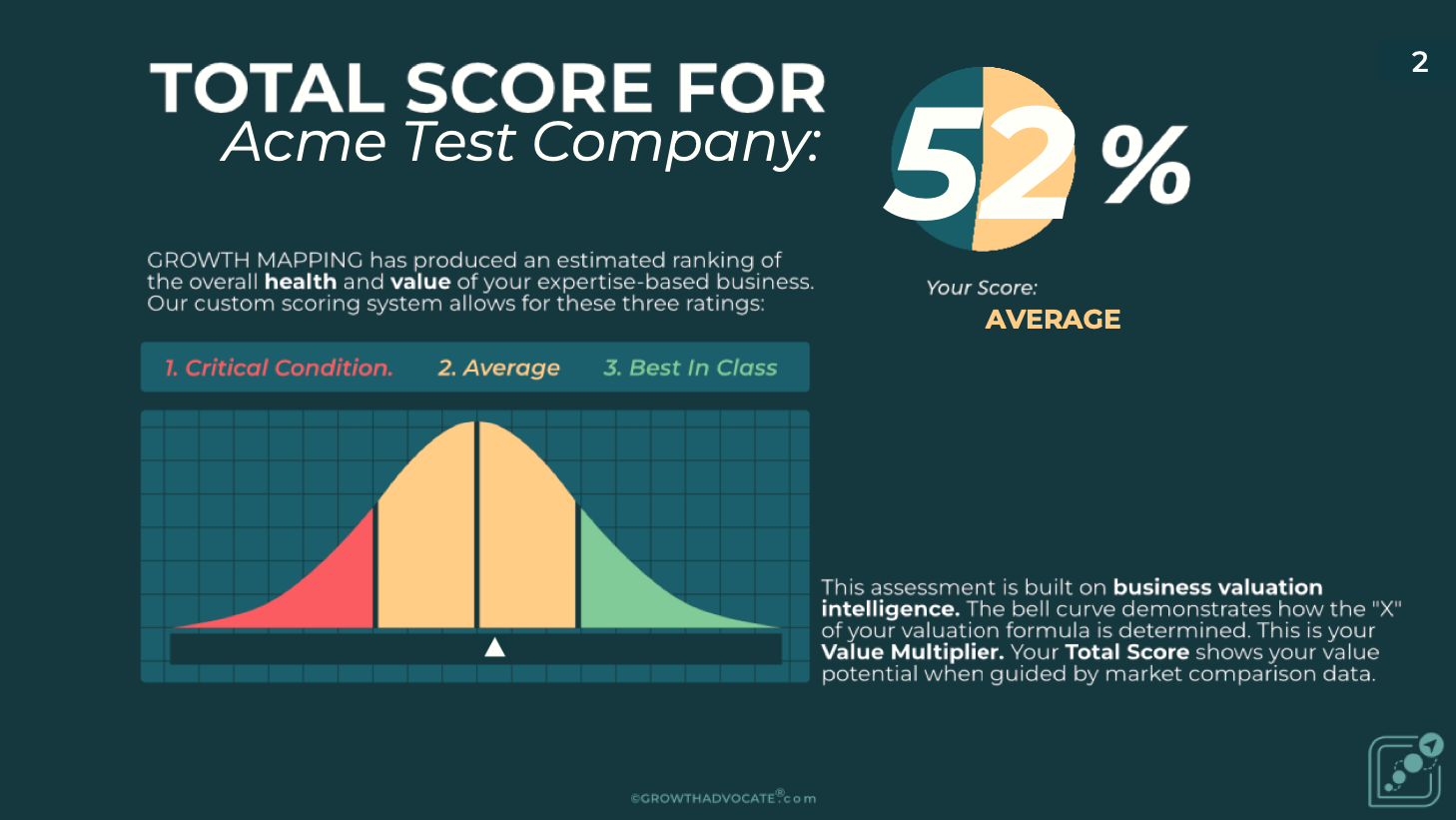
Composite Scoring

Composite Scoring
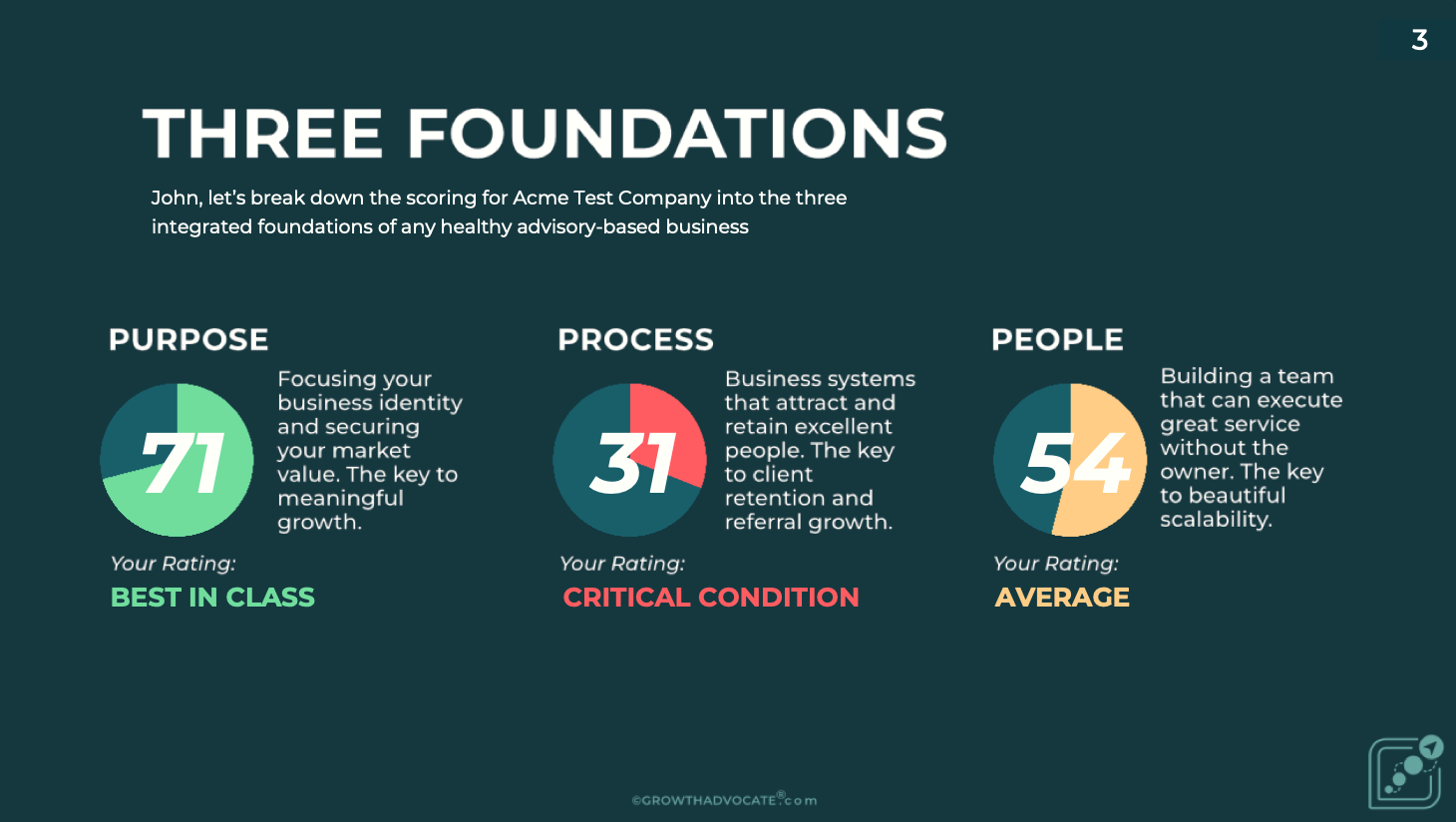
Three Foundations
Three Foundations
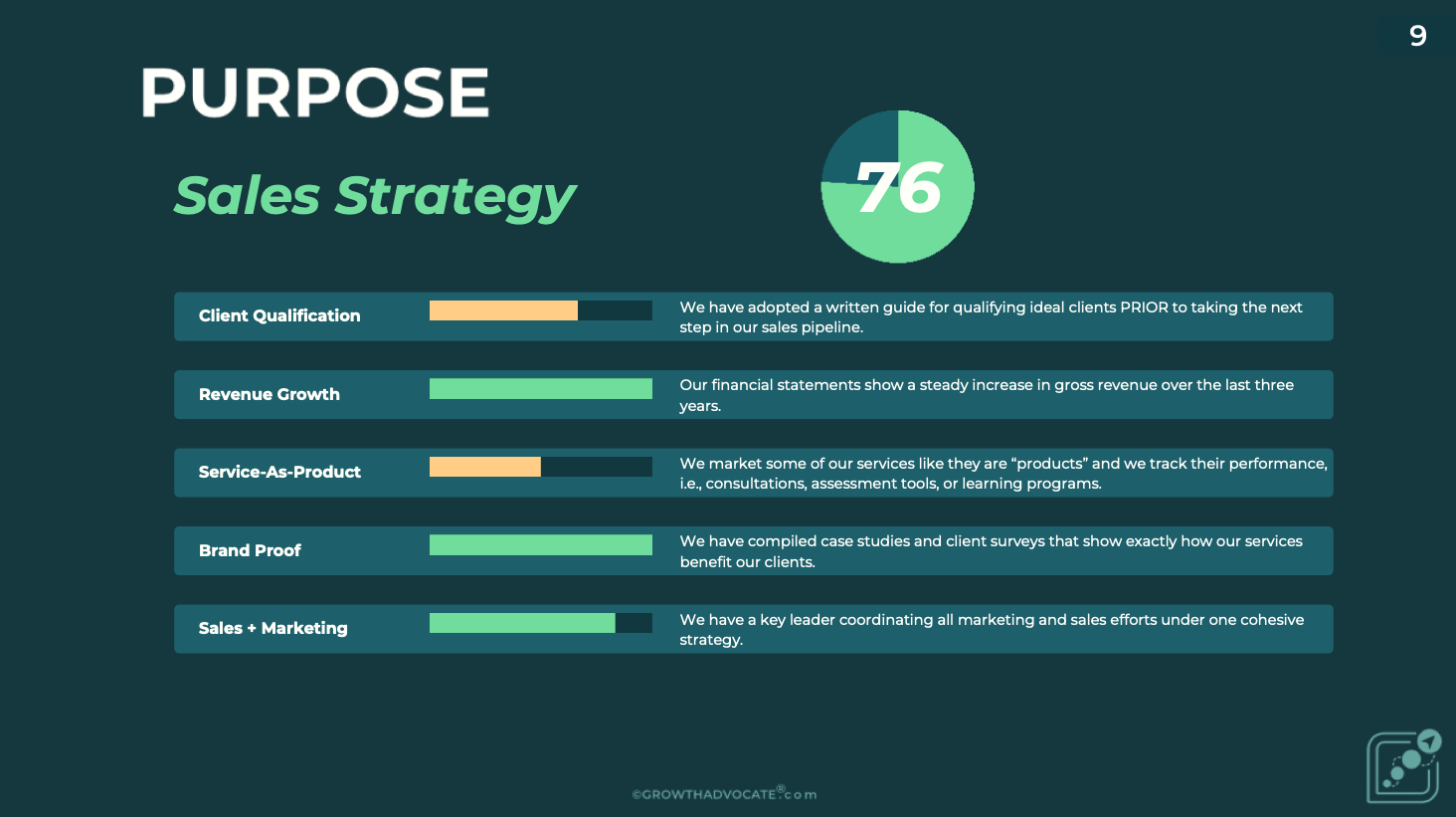
Category Detail
Category Detail
Next Steps
Next Steps
Why these seventy-five questions and not some other seventy-five.
Growth Mapping X is built on business valuation principles. Not the arithmetic — the intangibles.
When a business changes hands, the thing that moves the number most is rarely the earnings. It is the multiple applied to them, and that multiple is set by things that never appear on a financial statement. Whether the business runs when you are not in it. Whether your playbooks are written down or carried in one person's head. Whether a single client could leave with a third of your revenue. Whether your own name is still on the door.That list is what the seventy-five questions measure.
We do not produce a valuation and we publish no dollar figures. No EBITDA, no multiples, no number with a currency sign in front of it. What you get is your position on a comparison curve and a map of which intangibles are holding it down.
You do not have to be selling for any of this to matter. It is simply the best available list of what makes a business durable — and everything we do afterward moves it in the same direction.

H.B. Pasley built Growth Mapping during the years that he held the Certified Exit Planning Advisor designation, and that value-building framework shaped every question in the instrument. What it taught is still what the survey measures, and it is why the questions are about durability rather than activity.
What you get:
A written map, and it reads in a deliberate order, and you keep the full 28-page PDF report whether or not you work with us again.
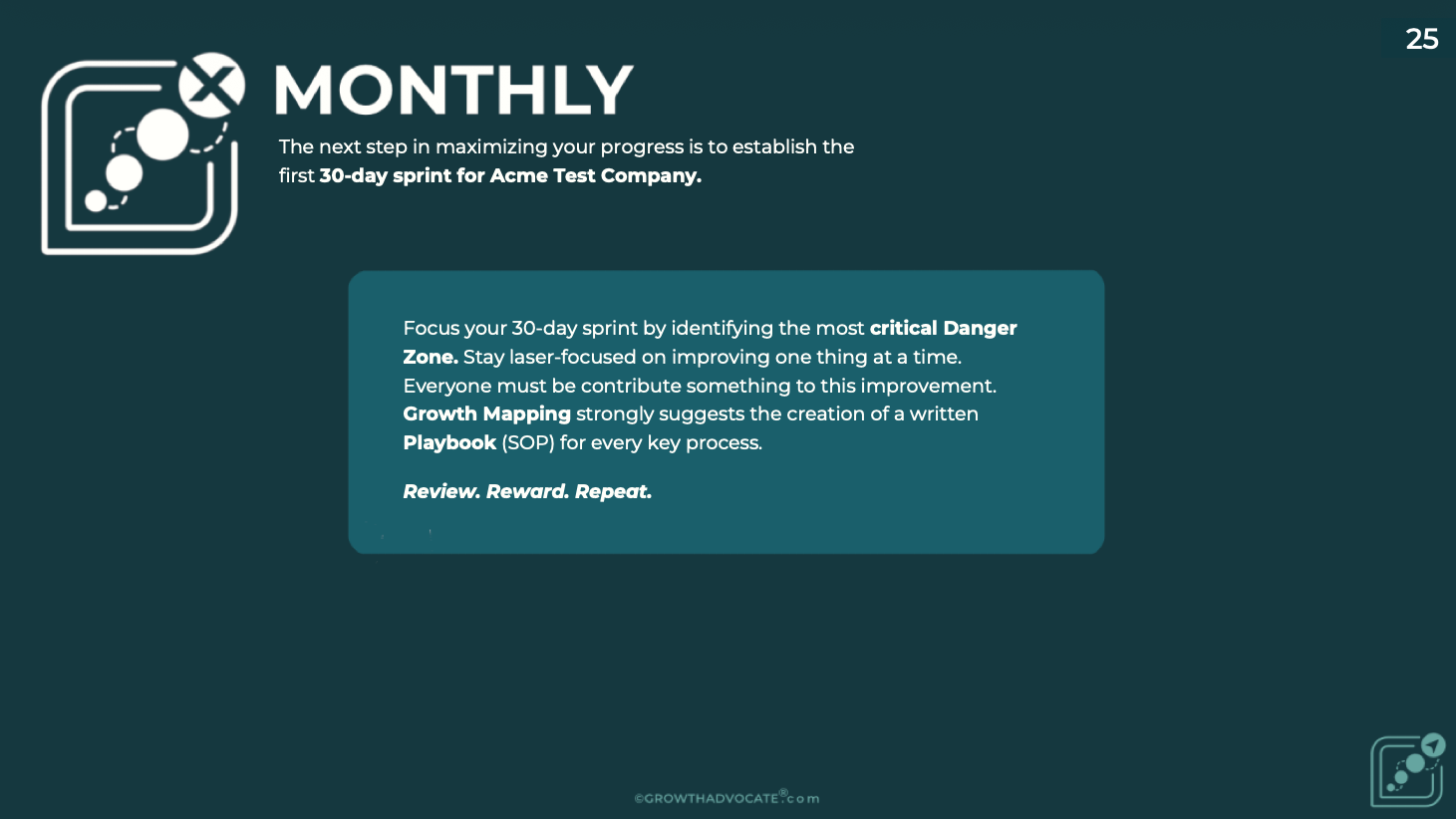
First, your strengths. The map opens with your highest-scoring foundation, names what your team has already done well, and tells you who to thank. Most owners have never had that conversation with evidence behind it. Second, your focus. One foundation, one category, one thing to fix in the next thirty days. Not a list of forty improvements that nobody starts. Third, the danger zones. Where something breaks if nothing changes, and in what order to deal with it.
First, your strengths. The map opens with your highest-scoring foundation, names what your team has already done well, and tells you who to thank. Most owners have never had that conversation with evidence behind it. Second, your focus. One foundation, one category, one thing to fix in the next thirty days. Not a list of forty improvements that nobody starts. Third, the danger zones. Where something breaks if nothing changes, and in what order to deal with it.
What happens after the map:
We suggest team meetings where we take the survey, then a follow up meeting where we bring your scores to the whole team — everyone in one room, on a screen — and we can run these meetings with you. We will work through your strengths and weaknesses together so everyone can contribute. Working together to brainstorm solutions becomes the pathway to writing playbooks to solve for the issues you prioritize. That is the key to improvement.
This experience creates a way to deal with company-wide challenges that will feel like a team project, not a criticism or confrontation. That is the whole reason it works, and it is why a business health assessment is worth doing together and not as a survey taken by one person.
This experience creates a way to deal with company-wide challenges that will feel like a team project, not a criticism or confrontation. That is the whole reason it works, and it is why a business health assessment is worth doing together and not as a survey taken by one person.
How do I know if my business is healthy?
Most owners sense something is wrong before they can name it — revenue flat, the same problems recurring, decisions routing through one person. A business health assessment replaces that instinct with evidence: a structured measurement of purpose, process and people showing which weakness is costing you most, in what order to address it, and what is strong enough to build on.
Business health assessment cost:
Growth Mapping X costs $1,500 and takes about thirty days because it is a short series of meetings: preparation, assessment, and follow-up toward action. A preparation meeting with you. The seventy-five point survey, taken online. A feedback session where we walk you and your leadership through the map and create an action playbook.
It is priced to be an easy decision. Most of what we do afterward is decided by what it finds, so getting it right matters more to us than what it earns. Even if you never engage us again, you will walk away with the beginnings of an action plan — one that any advisor you choose can work from.
It is priced to be an easy decision. Most of what we do afterward is decided by what it finds, so getting it right matters more to us than what it earns. Even if you never engage us again, you will walk away with the beginnings of an action plan — one that any advisor you choose can work from.
Why isn't it free?
A free diagnostic is often just a lead magnet that delivers little value. We invite you to take our free assessment as a way to see the kinds of topics we need to cover, but it is no replacement for a full evaluation and feedback session. So, if $1,500 is the wrong size of commitment right now, start with the free assessment instead and we believe you will see things you can start working on now.