Let me tell you about a mistake I see business owners make all the time.
A few months ago, I sat down with a financial advisor who had built a solid practice over fifteen years. Good revenue. Loyal clients. A small but dedicated team. But when I asked him what made his firm different—what his brand stood for—he looked at me like I'd asked him to explain quantum physics. He started listing services. He mentioned credentials. He told me about his fees being competitive.
What he couldn't tell me was his story. He couldn't articulate why someone should choose him over the dozen other advisors in his zip code. And here's the thing: if he couldn't say it clearly in a room with me, how could his team possibly communicate it to prospective clients? How could his marketing reflect something that didn't exist yet?
This is what happens when brand positioning gets treated as a marketing task instead of a leadership decision. It ends up buried in a slide deck somewhere, delegated to someone who doesn't have the authority to make the hard choices positioning requires.
The Real Problem Isn't Messaging—It's Clarity

Most business owners I work with have heard the term "brand positioning" before. Some have even hired agencies to help them with it. But when I dig into what actually got produced, I usually find a tagline, maybe a value proposition statement, and some messaging guidelines.
None of that is positioning.
Positioning is the set of strategic choices that determine how your business competes. It answers the questions most owners avoid: Who is this business really for? What will we commit to being known for? And equally important, what will we deliberately not pursue?
Avoiding those questions doesn't create flexibility. It creates drift. Your team starts telling different stories. Your marketing feels scattered. Your clients sense inconsistency even if they can't name it. And over time, your business becomes easier to replace.
I've learned this lesson the hard way. In my earlier ventures, I was guilty of wanting to be everything to everyone. I made lists of services thinking that was helpful. It took years of trial and error to realize that the list is the enemy of trust. When you try to appeal to everyone, you connect deeply with no one.
Why Positioning Belongs on the Leadership Agenda
Here's a truth that took me decades to fully understand: your brand is not what you say about yourself. Your brand is the story your ideal clients tell about you when you're not in the room.
If that story is unclear, it's not a marketing problem. It's a leadership problem.
Strong positioning requires alignment at the top. When leaders disagree about who the business serves, what it stands for, or how it should compete, customers experience that confusion externally. Different team members tell different stories. Priorities compete. The brand becomes harder to understand and easier to walk away from.
This is why I approach positioning as an alignment exercise first. Before we talk about logos or taglines or campaigns, we need everyone in leadership rowing in the same direction. We need shared clarity about the answers to four fundamental questions: Why does this business exist? How do we uniquely deliver value? What specific outcome do we provide? And who is the ideal person we serve?
These are the questions at the heart of the ARCHER methodology I've developed over years of working with service-based businesses. The metaphor comes from archery—and from a humbling experience I had at a shooting range in China when I discovered that aiming at the target almost guarantees you'll miss. You have to aim at the bullseye. In business terms: aim small, miss small.
The Courage to Choose One Thing
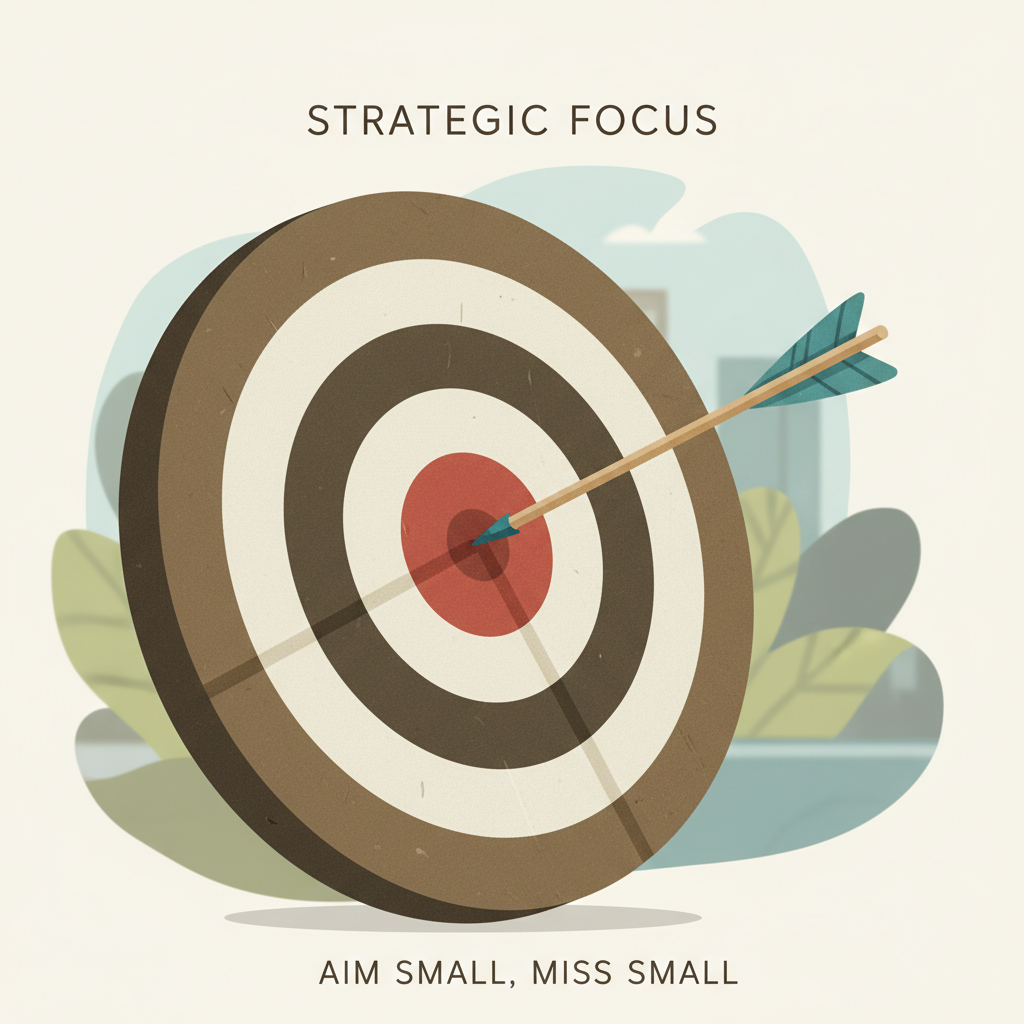
It takes real courage to narrow your value proposition down to one thing.
Most business owners resist this. They worry about leaving money on the table. They want to hedge their bets by keeping options open. I understand the impulse. But I've watched this play out hundreds of times, and the businesses that grow sustainably are the ones willing to make a choice.
Think about the arrow. It has one tip. Not three. Not five. One. If you've ever seen an arrow with multiple tips, you know it wouldn't fly straight. It certainly wouldn't hit the target.
Your value proposition works the same way. When you try to be known for everything, you become known for nothing. When you focus on one thing you can deliver better than anyone else—one thing your ideal clients desperately need—suddenly your message cuts through the noise.
The discovery process matters here. I encourage business owners to gather their teams and ask: What words do our best clients use to describe what we do for them? What do they focus on when they refer us to others? What deliverable are they happiest to pay for?
The answers to these questions often surprise people. The thing your clients value most is rarely the thing you lead with in your marketing. That gap is where positioning work lives.
It's Not About You—It's About Them
One of the most important lessons I've learned in forty years of leadership work is that the best client experiences are never about us. They're about the client.
This applies directly to positioning. A strong brand position isn't about proclaiming how great your business is. It's about articulating the transformation you create for the people you serve. It's about getting into their shoes, understanding their questions, and building everything around what they need to feel confident choosing you.
This is the foundation of the Ideal Client Experience framework I teach. Before you can position your brand effectively, you have to know exactly who you're positioning it for. Not some vague demographic. Not "busy professionals" or "high-net-worth individuals." You need to understand the specific hopes, fears, and desires of the people you're best at serving.
When you discover who you're best with—who is magically attracted to what you offer, who you're amazing at helping—that discovery process gives rise to something powerful. It becomes the foundation for everything: your messaging, your client experience, your hiring, your growth strategy.
Research Grounds the Conversation
I've sat in too many rooms where positioning discussions devolved into opinions and politics. The loudest voice wins. The founder's preference overrides customer reality. The result is a position that makes internal stakeholders happy but means nothing to the market.
This is why I believe positioning work should be informed by actual insight, not just instinct. If you have existing research—customer interviews, satisfaction surveys, competitive analysis—bring it into the room. Let it ground the conversation. It reduces anecdotal debate and accelerates alignment.
If you don't have research, consider getting some before you finalize your position. The goal isn't more data for its own sake. It's clarity about what your ideal clients actually care about, where competitors are falling short, and what your business can credibly own.
Research doesn't replace leadership judgment. Positioning is still a strategic choice, and leaders have to make it. But research ensures that choice reflects market reality rather than internal bias.
The Test for a Real Position
Here's a simple test I use to evaluate whether something is actually a brand position or just aspiration dressed up in nice language.
A genuine positioning statement must meet four criteria. First, it matters deeply to your target client. If they don't care about it, it's not positioning—it's wishful thinking. Second, your organization has the capability and genuine intent to deliver it. Promising something you can't consistently deliver destroys trust. Third, competitors are not delivering it, and would struggle to copy it. If everyone in your market can claim the same thing, it's not differentiation. Fourth, it's clear, compelling, and believable. Vague platitudes don't position anyone.
If your proposed position fails any of these tests, go back to the drawing board. Better to do the hard work now than to build marketing campaigns on a foundation of sand.
From Awareness to Insistence
Here's something most business owners don't fully appreciate: brand awareness is not the goal. Plenty of brands are well-known and still struggling.
The real goal is brand insistence—when your ideal clients choose you even when it's not the cheapest or most convenient option. When they seek you out specifically. When they refer you without being asked because they genuinely believe you're the best choice.
Insistence is built through the combination of relevant differentiation, perceived value, emotional connection, and consistent experience. Positioning is the foundation for all of that. Without a clear, owned position, even well-funded businesses struggle to create space in the minds of the people who matter most to their future.
Where Growth Advocate Can Help
.png)
If you're reading this and recognizing your own business in these patterns—the scattered messaging, the list of services, the inability to articulate what makes you different—know that you're not alone. Most service-based business owners face this challenge.
The work we do at Growth Advocate is designed to help leaders get clear. Through the ARCHER methodology, we guide business owners to discover their authentic story and articulate the Why, How, What, and Who of their business in a way that connects with ideal clients. Through Growth Mapping, we create visual frameworks for assessing where your business stands and planning actionable steps for sustainable growth. And through the Ideal Client Experience process, we help you design every touchpoint so your clients become advocates. See my book on client experience call Never Drop The Ball Again.
None of this is generic consulting. It starts with a personal conversation because I believe customized solutions are the only ones that stick. You're already doing great things. The question is whether your positioning reflects that clearly enough for the right people to find you.
A Final Thought
Brand positioning is not homework you assign to the marketing department. It's leadership work. It requires courage to make choices, humility to listen to your clients, and clarity to communicate what you stand for.
When you get it right, positioning becomes more than a marketing foundation. It becomes a decision lens for your entire organization—guiding everything from who you hire to how you serve clients to where you invest your energy.
The businesses that thrive long-term are the ones that know exactly who they are and who they're for. They've done the hard work of choosing. And they've built everything else on that foundation.
If you're ready to do that work, I'd love to talk.
H.B. Pasley, Growth Advocate®
Ready to clarify your brand story and connect with your ideal clients? Schedule a free consultation at GrowthAdvocate.com to see how our tools can transform your business.